

Ethiopia is a country of striking contrasts. It is home to the African Union, a hub of African aviation, and a nation with one of the oldest Christian histories in the world. Yet many of its churches have little access to sound, biblical teaching in the languages their people speak.
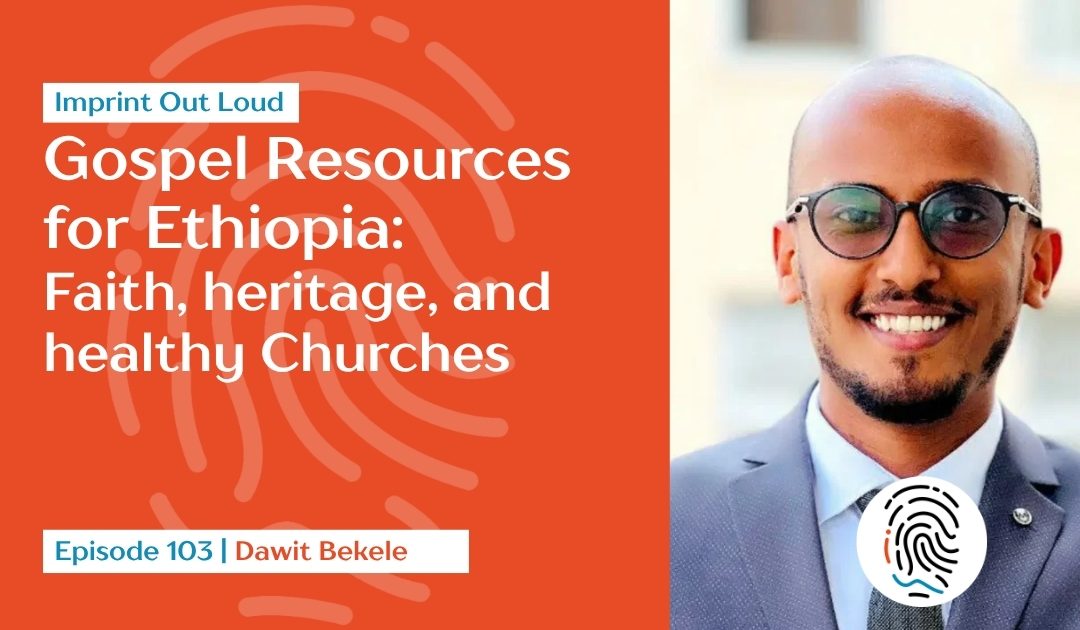
Dawit Bekele is a former lawyer turned publisher in Addis Ababa, director of Wongelu Ministries. In a recent conversation, Dawit explained some of his personal history and described Wongelu’s work in Ethiopia.
Personal Journey to Faith
Dawit was born into a Christian home in a poor community in Addis Ababa and grew up serving in the church. Looking back, he now counts that upbringing among his greatest blessings. “If you’re born in a Christian home,” he says, “God is protecting you from so much baggage of sin.” He admits that, as a younger man, he sometimes wondered whether he might have understood grace better had he come from outside the faith.
His own conversion came in his high school years, and it began with an argument. He was debating an atheist friend whose father was also an unbeliever, and he would carry his friend’s objections home to his father, a Christian, and return with answers. In one conversation about the resurrection, his friend turned the question around. Did Dawit actually believe that Jesus was born of a virgin, died for his sins, rose again and would return? Dawit admitted he did. His friend replied that even if Dawit could convince him of every argument, he still would not believe.
That exchange exposed the gap between knowing something and believing it. Dawit realised he had been trying to win a debate, not trust a Saviour. Faith, he saw, is a gift.
After high school he studied law and, while leading a Bible study in his university fellowship, he came to a clearer understanding of conversion. Raised in a Pentecostal setting, he was introduced to Reformed resources that he now regards as healthy and biblical. “It is by God’s grace,” he says, “that I’ve come through this journey.”
A Rich Heritage, a Complicated Inheritance
To understand the church in Ethiopia, Dawit says, you have to understand its history. Ethiopian tradition holds that the Queen of Sheba, who visited Solomon, bore a son by him: Menelik I, the first emperor, who traced his line back to King David. Every emperor until the late 1960s, including Haile Selassie, claimed that lineage. The Ethiopian eunuch of Acts 8 returned home with the gospel and, in AD 326, King Ezana declared Christianity the state religion, making Ethiopia one of the first nations to do so.
That heritage brings real strengths, but also a serious obstacle. The Ethiopian Orthodox tradition, which dominates in the north, is deeply bound up with legalism and with the authority of tradition and the church fathers, which it often places above Scripture. When evangelicals argue for justification by faith alone, or the final authority of Scripture, they are told these are sixteenth-century inventions, since the Ethiopian church claims an unbroken line stretching back long before. Because evangelicals do not look to Mary or the angels as mediators, they are sometimes accused of denying Mary altogether. Some of the country’s traditions go further still. Many Ethiopians believe the Ark of the Covenant rests in Aksum, in the north, and the church officially endorses that claim.
Islam is present too, strongest in the east, though Dawit does not see it as a major threat at present, and he allows that this may change in the next decade.
Trouble Inside the Evangelical Church
Evangelicals make up a little over a fifth of the population, and most of them are Pentecostal. Dawit is quick to say that the gospel is present and that Ethiopia is not unevangelised. But it has been tainted. He points to legalism, the prosperity gospel, an unhealthy fixation on demons and the spiritual world, and pastors who exercise authority over their flocks without biblical warrant.
There is also trouble from another direction. Some theologically trained Ethiopians go abroad for study and return with a postmodern outlook. They speak of an “authentic, indigenous” approach to worship and teaching, which need not be Westernised. It sounds attractive at first but it gradually makes Scripture subjective. The fruit, after twenty or thirty years, is plain to see: little repentance, no clear teaching on what Christ accomplished on the cross, and a denial of substitution, atonement, and imputation.
When asked how many healthy, gospel-preaching churches he knows of in the country, Dawit answers: three or four. Those are the only ones he would confidently recommend to a visitor. Even so, he sees encouraging signs of healthy churches slowly emerging.
From Pastoral Internship to Publishing Ministry
After law school, Dawit practised for a few years before undertaking a pastoral internship in Ras Al Khaimah in the United Arab Emirates. It was not an easy thing to explain to his family. But it proved decisive. He had long known the problems at home, among them the prosperity gospel and weak teaching. What he lacked was the solution. In the UAE he saw that the doctrines of grace could be taught in a local church without becoming divisive, and that the beauty of the gospel could be lived out together.
He returned to Ethiopia with friends who had done the same internship, some of whom were working towards planting churches. Church planting, Dawit says, is the most important work. Beside it stands the need for resources, because new churches need material to teach from. Out of that need came Wongelu, which means “the gospel” in Amharic.
The language situation makes the need acute. Amharic is the official language and is spoken only by Ethiopians, but the country has over eighty ethnic groups and more than a hundred languages. For many years, Ethiopia has also been relatively closed to the outside world. As Dawit notes, there is no Starbucks, no McDonald’s, no international credit card companies. That isolation helped Ethiopia preserve its identity, but it also meant that the great stream of Christian books, hymns, and teaching reaching other African nations never really arrived. English songs have never been translated into Amharic. Believers struggling with depression or pornography have had almost nothing to read in their own language. When Wongelu worked with Desiring God to compile the hundred most common questions from Ethiopia, Dawit was struck by how basic many of them were: what it means to be saved, what the Bible says about abortion.
Translating for the Pastor and the Mother
Wongelu’s aim is not to westernise Ethiopian Christianity but to bring the truths the church has taught for centuries to Ethiopian believers in a form they can understand. The ministry partners with Desiring God, 9Marks, Ligonier, Crossway, Truth for Life, and others, translating their material into Amharic, and now Afaan Oromo as well, with more languages planned.
In about four years, the ministry has produced twenty to thirty resources, including devotionals, songs, and several books. Some are in print and some are digital. Wongelu is not for profit and sells its print resources to local churches at cost. Almost everything is also available as free audio, accessed by scanning a QR code that leads to a landing page. Dawit’s goal is to produce material that “a theologically educated guy could pick up and understand,” and that “the mother feeding three kids while she’s listening to the audio” can follow just as readily.
The ministry hopes to follow in Imprint’s footsteps by running intensives and workshops where pastors gather to be taught about church membership, conversion, the marks of a healthy church and the ordinances of baptism and the Lord’s Supper.
Dawit is also generous towards his Pentecostal brothers and sisters. “We don’t consider Pentecostal churches to be our enemies,” he says. There are practices that need correcting, but they are brothers who believe in the same Lord and share the same concern for the church. Wongelu wants to work with them, not against them.
Similar publishing movements are springing up across the continent, in Ivory Coast, Egypt, Kenya, Zambia, Cameroon, Nigeria, and South Africa. A decade or fifteen years ago, Dawit says, there was almost nothing. Now there is a great deal of activity.
Why Faithful Work Matters
Dawit ended the conversation with an encouragement for anyone in ministry who feels their work is small or unnoticed, especially in a world that demands everything immediately. His own theology was shaped by a series of sermons on Romans that R. C. Sproul preached decades ago. Sproul could never have known that a young man in Ethiopia would one day listen to them and be changed.
The resources we produce today, Dawit says, will remain long after we are gone, for twenty, fifty, even a hundred years. If we take the credit for them, the credit is not God’s. But if we simply keep faithfully doing what God has commanded, he will bless it in his time. Dawit has already seen some fruit after just a few years, and he takes it as an encouragement from the Lord. Even if he saw none, he would draw comfort from men like William Carey and William Wilberforce, who sowed faithfully and did not live to see the harvest.
“As long as we’re doing what God commanded us,” he says, “we can sleep happy and joyful, saying, I’ve farmed, I’ve tilled the ground.”
To see Wongelu’s resources, visit wongelu.com. Pray for Ethiopia: for the growth of healthy churches, for faithful pastors, and for the translation and distribution of sound resources in every language of the country.