
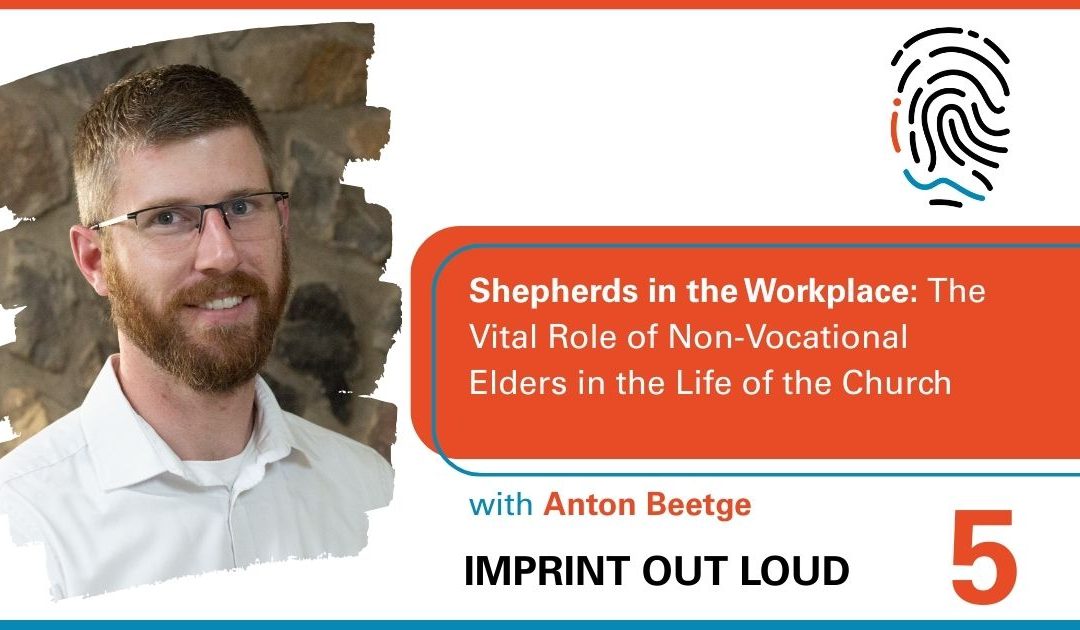
Healthy churches require faithful shepherds. While many Christians are familiar with the role of a fulltime or vocational pastor, many churches are also served by elders who carry out pastoral responsibilities while working in ordinary professions. These men are often referred to as lay elders, unpaid elders, or non-vocational elders.
Episode #5—Shepherds in the Workplace: The Vital Role of Non-Vocational Elders in the Life of the Church
Understanding the Call to Eldership
Discussions about “being called” to ministry can sometimes be misunderstood. Pastoral calls rarely come through a dramatic or mystical experiences, but ordinarily through a combination of personal desire and the recognition of the church.
I was raised in a pastor’s home, and was fairly certain that God was not calling me into fulltime pastoral ministry. I pursued dentistry as a career but, over time my love for the Lord, for Scripture, and for the church deepened. Gradually, I became convinced that the Lord might call me to serve the church in some form of ministry, though not necessarily in a fulltime capacity.
At one point, I shared this possibility with his wife. Though she was initially hesitant, we began to pray about the matter together. Not long afterwards, our pastor approached me and asked whether I had ever considered serving as an elder. That moment served as a significant confirmation of what I had already begun to sense.
This pattern reflects the biblical framework for eldership. In 1 Timothy 3:1, Paul writes, “If anyone aspires to the office of overseer, he desires a noble task.” There is a personal aspiration for the work, but the church must also recognise and affirm the calling. In my case, other believers—friends and church leaders—had begun to notice the same gifts and character qualities.
The call, therefore, involved two important elements: a desire to serve and the affirmation of the church.
The Process of Becoming an Elder
After this initial conversation, the process unfolded gradually rather than immediately. I spent time in prayer and discussion with my wife, recognising that my first calling was to his family. If I were to serve as an elder, it could not come at the expense of my responsibilities as a husband and father.
Once there was mutual peace about the direction, I began attending elders’ meetings as an observer. During this period, I also read extensively about eldership, ecclesiology, and church life. The transition required a shift in perspective—from thinking merely as one of the sheep to beginning to think as a shepherd.
At the same time, the congregation was given opportunity to observe my ministry. I began teaching adult Sunday school classes, leading Bible studies in midweek groups, and occasionally preaching to the congregation. This exposure allowed both the church and me to evaluate whether my gifts were suited to pastoral ministry.
Eventually, my name was formally announced as an elder candidate. After an observation period of roughly eighteen months, the church affirmed me as an elder.
Spiritual Growth Through Responsibility
Serving as an elder brought significant spiritual growth. Some of the most profound growth in my Christian life occurred during the years leading up to and following my appointment.
Part of that growth came from the weight of responsibility. Shepherding souls is not a light matter, and the role compelled me to pursue deeper study, more focused reading, and greater spiritual discipline.
Another important factor was serving alongside other elders. Being part of an eldership team means interacting regularly with men who often have more experience and wisdom. These relationships sharpen one another spiritually and practically.
Yet eldership also requires humility. Decisions are not made individually but collectively. An elder must be willing to defend his views while also submitting to the wisdom of the group. At times, the final decision may differ from what one person might have chosen on his own.
This dynamic reflects the nature of the church itself. Christ has not called believers merely as individuals but as members of a body. In many ways, the eldership is a microcosm of that corporate life.
Should Every Man Aspire to Be an Elder?
Scripture describes the qualifications for elders in passages such as 1 Timothy 3:1–7. Many of these qualifications are character traits that every Christian man should pursue: sobriety, self-control, faithfulness in the home, and a good reputation. In that sense, every man should aspire to the kind of maturity described there.
However, that does not necessarily mean every man should aspire to the office itself. While the character qualities are broadly applicable, the role includes specific requirements that not every believer will possess. One example is the ability to teach, which Paul explicitly lists among the qualifications.
Furthermore, the value of a church member is not measured by whether he holds the office of elder. A faithful member is no less valuable to Christ than a church leader. God calls and equips believers in different ways for the building up of the body.
Nevertheless, elders serve as examples to the congregation, modelling the Christian life. As Paul exhorts elsewhere, believers should be able to say, in effect, “Follow my example as I follow Christ.”
Balancing Eldership with a Fulltime Career
One of the most challenging aspects of lay eldership is time management. I work fulltime as a dentist, often with demanding hours. In addition to professional responsibilities, I must also prepare sermons, attend elders’ meetings, counsel church members, and participate in various forms of shepherding.
How does I find the time? Part of the answer lies in priorities. If something is truly important, time must be made for it. Yet priorities also impose boundaries. My calling as an elder must never cause me to neglect responsibilities as a husband, father, or church member.
Serving faithfully therefore requires sacrifice. Often, that sacrifice comes in the form of reducing leisure activities, hobbies, or entertainment. Early mornings, late evenings, and careful planning become essential. Sermon preparation, for example, cannot be left until the final days before preaching.
By planning well in advance, I have been able to manage my responsibilities without unnecessary pressure.
Differences Between Vocational and Non-Vocational Elders
The most obvious difference between vocational and lay elders is time. A vocational elder is financially supported by the church and is therefore free to devote working hours to pastoral ministry. This allows me to spend more time in counselling, sermon preparation, administration, and general shepherding.
Because of this availability, church members often instinctively approach staff elders first when they need help or guidance. However, the spiritual role of both types of elders remains fundamentally the same. Both share the responsibility of shepherding the flock, guarding doctrine, and caring for the church.
Each role also brings unique strengths. A vocational elder may have greater time for study and therefore be able to consult a wider range of resources when preparing sermons. A lay elder, on the other hand, often identifies more directly with the everyday working life of most church members. His experience in the workplace can help him connect with the ordinary rhythms and pressures that many believers face.
In this way, the plurality of elders becomes a strength. Just as the body of Christ contains many members with different gifts, so an eldership team benefits from a diversity of experiences and abilities.
Maintaining Unity Within the Eldership
Unity among elders is essential for the health of the church. When some elders serve fulltime and others part-time, maintaining close relationships becomes even more important. This can be cultivated in several ways.
First, there must be trust. Elders must trust one another’s character and judgement rather than constantly second-guessing every decision.
Second, personal relationships matter. Spending time together outside formal meetings—sharing meals, having coffee, and cultivating genuine fellowship—strengthens the bonds between leaders.
Finally, communication is essential. Like a healthy marriage, good communication prevents misunderstandings and fosters unity. Elders must be intentional about keeping one another informed and involved in the work of shepherding.
Ultimately, the goal is not to build individual ministries but to serve together as fellow servants of Christ. Elders are teammates labouring for the same purpose: the building of Christ’s church.
The Value of Faithful Lay Elders
The New Testament vision of church leadership is not built around a single individual but a plurality of elders working together for the good of the flock. Within that structure, lay elders play a vital role.
Though they often serve quietly alongside demanding careers and family responsibilities, their contribution strengthens the church. Their presence broadens the leadership team, enriches pastoral care, and reflects the shared responsibility of shepherding God’s people.
For churches seeking to remain faithful to the biblical pattern, the faithful service of lay elders is both a gift and a blessing.